

Duvet Cover Set Queen Size Guide: Fit, Fabric and Care
The most repeated advice about duvet covers is also the one that sends the most sets back. Buy the size that matches your mattress, the guides say. Order queen for a queen bed. So you do, and the cover arrives with corners that hang empty, a middle that bunches, and a sham that doesn't fit your pillows.
The label isn't lying. It's just doing very little work. A US queen mattress measures 60 × 80 inches, while the covers sold as queen are deliberately cut larger, commonly 90 × 90 inches but also 88 × 88 or 92 × 90 depending on the manufacturer. Those extra inches are the drape. Once your mattress depth claims its share, whether the cover looks fitted or sloppy depends on numbers that have nothing to do with the word on the package.
A duvet cover set is a washable shell, two shams, and a set of assumptions about fit, fabric, and care. The size name is the least reliable part of the purchase. The three things that determine the outcome are the dimensions of your insert, the depth of your mattress, and how the fabric behaves after five washes.
Table of Contents
- What a Queen Duvet Cover Set Includes
- Queen Duvet Cover Size Chart
- Measure Your Insert, Mattress Depth and Target Drop
- Fabric and Weave Choices That Change the Feel
- How to Wash and Dry a Queen Duvet Cover Set
- Real-World Examples of Choosing a Queen Set
- Five-Point Pre-Purchase Check Before You Buy
What a Queen Duvet Cover Set Includes
A duvet cover set is the layer you wash, not the layer you sleep under. That one distinction explains most of what you're buying.
A duvet cover is a removable fabric shell that slips over a duvet insert or comforter. The insert does the insulating. The cover does everything else: it shields the insert from body oils and dust, it sets the color and texture of the bed, and it's the piece that goes into the washing machine. Most covers close with buttons, snaps or a hidden zipper along one end and carry an interior tie at each corner, so you can fasten the insert's corners and stop the filling from sliding to one end overnight.
The set part means the shams come with it. A standard three-piece configuration is one cover plus two standard shams measuring about 20 × 26 inches, the size that fits ordinary pillows rather than king pillows. Buying the set instead of a bare cover solves a small but real problem: the match is already made, so you aren't hunting for shams in a compatible dye lot six weeks later.
What the set does for you: the insert stays clean, laundering a light cotton shell is far easier than washing a bulky comforter, and a second cover in another color refreshes the whole room for less than the price of new bedding.
Three pieces, three jobs. The cover protects and displays. The shams finish the bed. The closure and corner ties keep the insert where you put it, which matters more than most shoppers expect, because an insert that migrates overnight turns a made bed into a lumpy one by morning.
Four decisions separate a set you keep from one you return: exact fit, included pieces, fabric behavior, and the care the fabric will demand. Everything else, including the word printed on the package, is merchandising.
Queen Duvet Cover Size Chart
Start with the numbers, then learn to read them. The chart below pairs standard US mattress dimensions with the cover cuts sold as queen, so you can see exactly where the slack goes.
| Item | Typical size (inches) | What to check |
|---|---|---|
| Queen mattress | 60 × 80 | the base for every drop calculation |
| Full mattress | 53 × 75 | why shared full/queen labels can fit badly |
| Queen duvet cover, most common cut | 90 × 90 | about 15 in of side overhang before mattress depth |
| Queen duvet cover, other common cuts | 88 × 88 to 92 × 90 | compare with the insert, not the label |
| Standard pillow shams, 2 per set | 20 × 26 | confirm your pillows are standard size |
| Recommended ease of cover over insert | about 1 to 2 in per side | a close fit stops the insert shifting and bunching |
The mattress row. 60 × 80 inches is the surface every calculation starts from, as Joss & Main's queen duvet cover sizing guide sets out. No cover changes that.
The full row. At 53 × 75 inches, a full mattress is seven inches narrower and five inches shorter than a queen. That gap is why one cover labeled Full/Queen can look snug on one bed and baggy on the other. Queen covers aren't interchangeable with full or double covers, even when a retailer prints both names on the same product.
The common cut row. A 90 × 90 inch cover is 30 inches wider than a 60-inch mattress, giving roughly 15 inches of potential overhang per side before mattress depth, bedding layers or construction tolerances take their share. In metric that's about 228.6 × 228.6 centimeters. Subtract your mattress depth from 15 and you have the drape you'll see.
The other cuts row. Published US queen covers also run 88 × 88 and 92 × 90 inches. Two covers with the same name can differ by four inches in width, which is the entire argument against shopping by label.
The sham row. Two 20 × 26 inch shams come in a standard set. They fit standard pillows. King pillows need king shams, and cramming them in stretches the seam.
Here's the rule that resolves all of it: a duvet cover is sized to the insert, not to the mattress. The cover should match your insert's width and length or run a couple of inches larger in each direction. Anything looser and the insert slides; anything tighter and it bunches at the corners.
Before checkout, copy the listing's exact cover and sham dimensions and hold them against your insert. Sizing isn't globally uniform either, since UK and European bedding systems use different mattress and duvet dimensions, so a metric "queen" imported from elsewhere may not line up with a US insert at all.
Measure Your Insert, Mattress Depth and Target Drop
Fifteen minutes with a tape measure replaces guesswork with three numbers you can shop against.
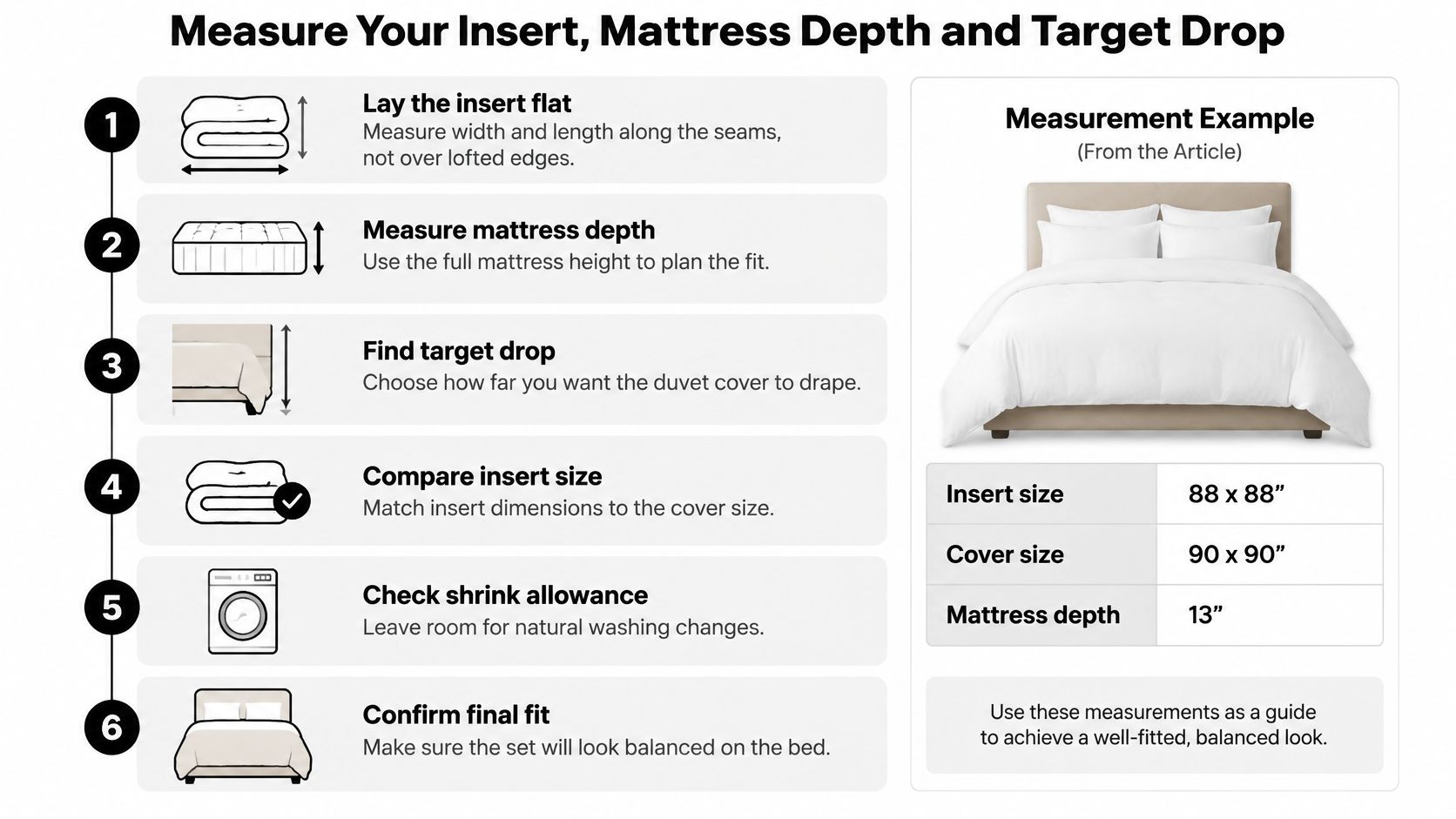
- Lay the insert flat on a hard floor. Measure width first, then length, running the tape along the seams rather than over the lofted middle. A puffy insert measured across its crown reads two or three inches bigger than it is, and that phantom size leads you to a cover that's too large.
- Measure mattress depth at the center of the bed. Include any topper, pillow-top or mattress pad. Depth is the number that eats your side drape, and it's the one shoppers forget. A 10-inch mattress and a 15-inch pillow-top take the same 90 × 90 cover and produce completely different beds.
- Decide your target drop. This is how far you want the cover to hang past the mattress edge. On a standard frame, a drop that reaches just past the side rails looks intentional; a drop that reaches near the floor looks generous but hides the frame. Write down which look you want before you look at any listing.
- Compare the insert to the cover's listed dimensions. Use the ease allowance from the chart: close, not generous. As Apartment Therapy's bedding measurement guide points out, a queen label doesn't tell you which cut you're getting, and oversized covers create their own problems.
- Add a shrinkage margin for cotton. Heat pulls cotton in slightly, so a cover that fits perfectly on day one can tighten after a few hot dry cycles. Favor the middle of your acceptable range rather than the tightest fit that works.
- Check the closure and the corner ties. These do more for daily fit than an extra inch of fabric ever will. Interior ties at all four corners plus a real closure keep the insert from migrating, which is what makes a bed look slept-in by noon.
A deep or pillow-top mattress may need the next cut up, or a king cover used on a queen bed for full drape. Oversized isn't automatically better: extra fabric lets the insert shift into folds, and you'll spend the next year smoothing it.
Write these three numbers down before you shop: insert width and length, mattress depth including toppers, and your target drop. Every listing question you have after that is answered by comparing them.
Fabric and Weave Choices That Change the Feel
Fiber and construction are performance variables, not quality guarantees. The same 100% cotton can arrive crisp and glassy or soft and rumpled depending on how it was woven and finished.
Cotton is the default for a reason. In Cotton Incorporated's 2024 Global Home Textiles Survey of 7,163 consumers across five markets, 64% preferred cotton, and their stated priorities were quality at 75%, durability to laundering at 69% and softness at 68%. Those three numbers describe most of what a duvet cover has to do.
| Fabric | Feel | Durability and care | Best for |
|---|---|---|---|
| Washed cotton | relaxed and soft from the first wash | machine wash cool, can shrink with heat | everyday casual bedrooms |
| Percale cotton (plain weave) | crisp, cool, matte | sturdy, softens with each wash | hot sleepers and a hotel-style bed |
| Sateen cotton | smooth with a subtle sheen | elegant but more prone to snags | a dressed-up, polished bed |
| Linen | airy and textured, softens with age | very durable, wrinkles readily | warm climates and relaxed styling |
| Microfiber (polyester) | plush and budget-friendly | traps heat and can pill over time | guest rooms and short-term use |
Weave sets the hand
Plain weave, sold as percale, uses a simple over-under structure that produces a crisper, more stable surface. It feels cool at first touch and gets softer with laundering without losing its body.
Sateen exposes more yarn floats on the surface, which makes it smoother and more lustrous. It drapes beautifully and shows off a made bed. It's also more vulnerable to snagging around rings, pet claws and zipper pulls, so keep that trade-off in mind rather than treating sateen as an upgrade.
Washed cotton has been mechanically or chemically softened before sale. You get the relaxed, broken-in hand on night one instead of after a month of washing, at the cost of some of that crisp structure. Our tan gingham washed cotton duvet cover set is built on that finish, which suits a casual room better than a formal one.
What thread count does and doesn't tell you
A representative queen cotton sateen specification is 100% cotton at 400 thread count, with a 90 × 92 inch cover and 20 × 26 inch shams. That's a normal, sound spec. It's also not a ranking, because thread count depends on yarn thickness, ply, weave density and finishing, and some manufacturers count individual fibers rather than yarns to inflate the figure.
Read the spec sheet for the things that change your week: fiber percentage, weave name, fabric weight or GSM if it's listed, closure type, corner ties, and wash temperature and drying limits. OEKO-TEX Standard 100 is worth having on the label, but understand what it covers: chemical safety, not warmth, breathability, strength or shrinkage.
Linen earns its place in warm bedrooms and relaxed styling, though it wrinkles on purpose. Microfiber suits guest rooms and short-term rentals where budget matters more than breathability.
How to Wash and Dry a Queen Duvet Cover Set
Care advice usually stops at "follow the label." The label tells you temperature. It doesn't tell you that a long cycle and a heavy detergent dose cost you fabric, or that a laundry ball adds to the problem.
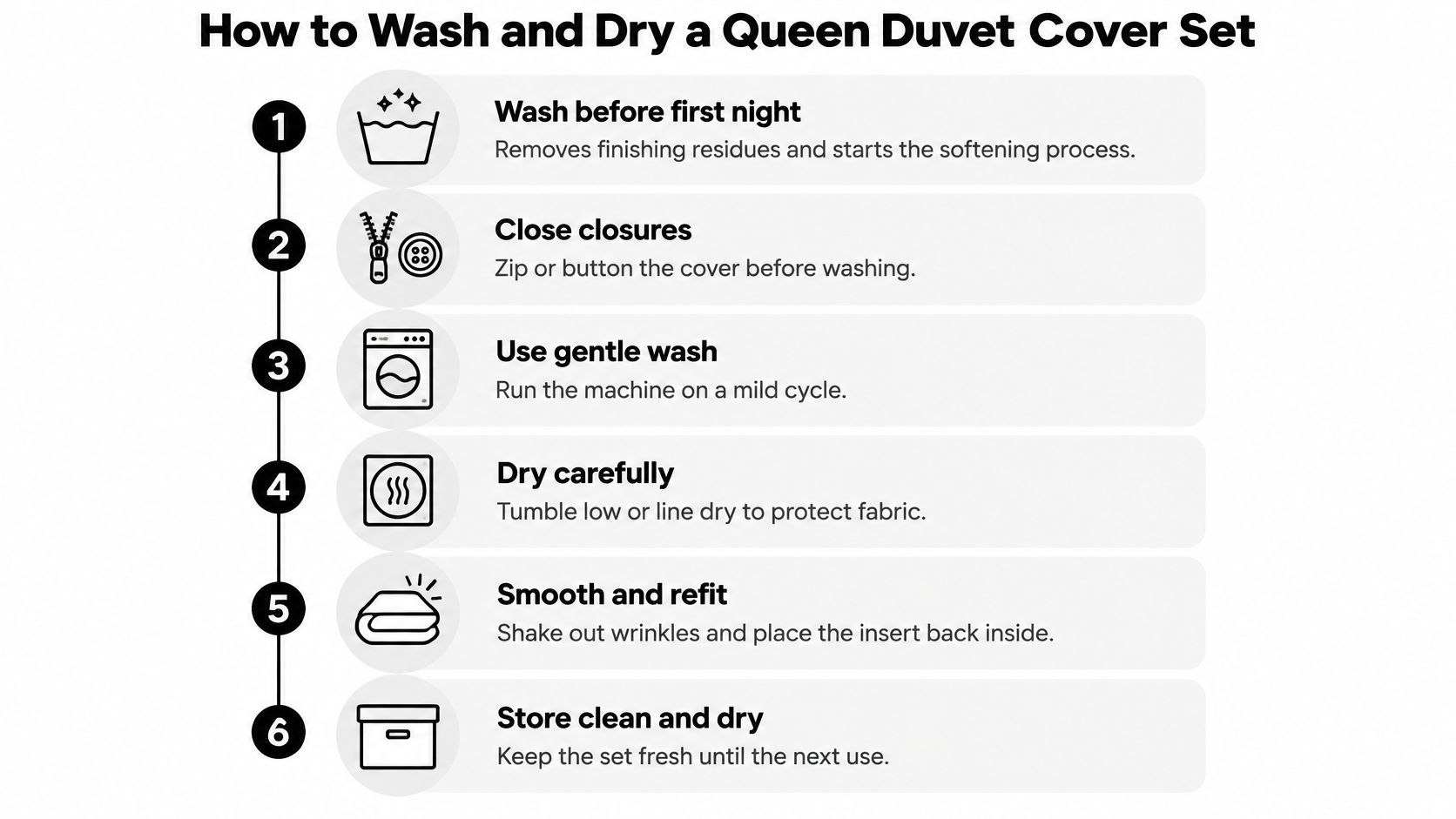
Here's the protocol I'd give anyone with a washed-cotton set.
- Wash the set before the first night. Finishing residues from manufacturing sit on the surface and can feel stiff. One cool wash removes them and starts the softening process you paid for.
- Close every closure and wash the cover separately or with like colors. An open zipper or a row of buttons tumbling against the face fabric abrades it. Separate washing also keeps lint and dye transfer off a pale cover.
- Run a normal cycle, not the longest one available. A 2025 laboratory study on laundering and fiber release found that detergent and wash time were the major influences on fiber shedding, and that adding a laundry ball raised shedding by roughly 10% to 60% across tested fabrics. Skip the extras.
- Dose detergent properly in both directions. Enough to clean, not so much that residue stiffens the fibers. Excess detergent is the most common cause of a cover that feels scratchy after a month.
- Follow the label's temperature and default to cool or warm. Cotton shrinks when exposed to heat, and shrinkage is what turns a well-fitted cover into a tight one.
- Tumble dry low or line dry, then refit while slightly damp. Pull the cover out early, shake it, and dress the bed. Repeated high-heat cycles degrade cotton fibers over time, and the set loses both softness and dimensional stability.
Store a spare set fully dry in a breathable cotton bag rather than a vacuum-sealed plastic one, so it doesn't pick up a stale smell between seasons.
The honest nuance: cotton isn't plastic. Cotton fibers are cellulose, while synthetic microfibers are petroleum-derived, and they don't carry the same environmental story. But cotton still sheds, and the same study measured average cotton fiber release of about 617.34 ± 85.2 milligrams per kilogram per wash. Gentler cycles extend the life of your set and reduce what goes down the drain at the same time.
Real-World Examples of Choosing a Queen Set
Two beds, two covers, two completely different right answers. The math is the same in both cases.
Take a shopper with a 13-inch pillow-top mattress and an 88 × 88 inch insert considering a 90 × 90 washed-cotton gingham three-piece set.
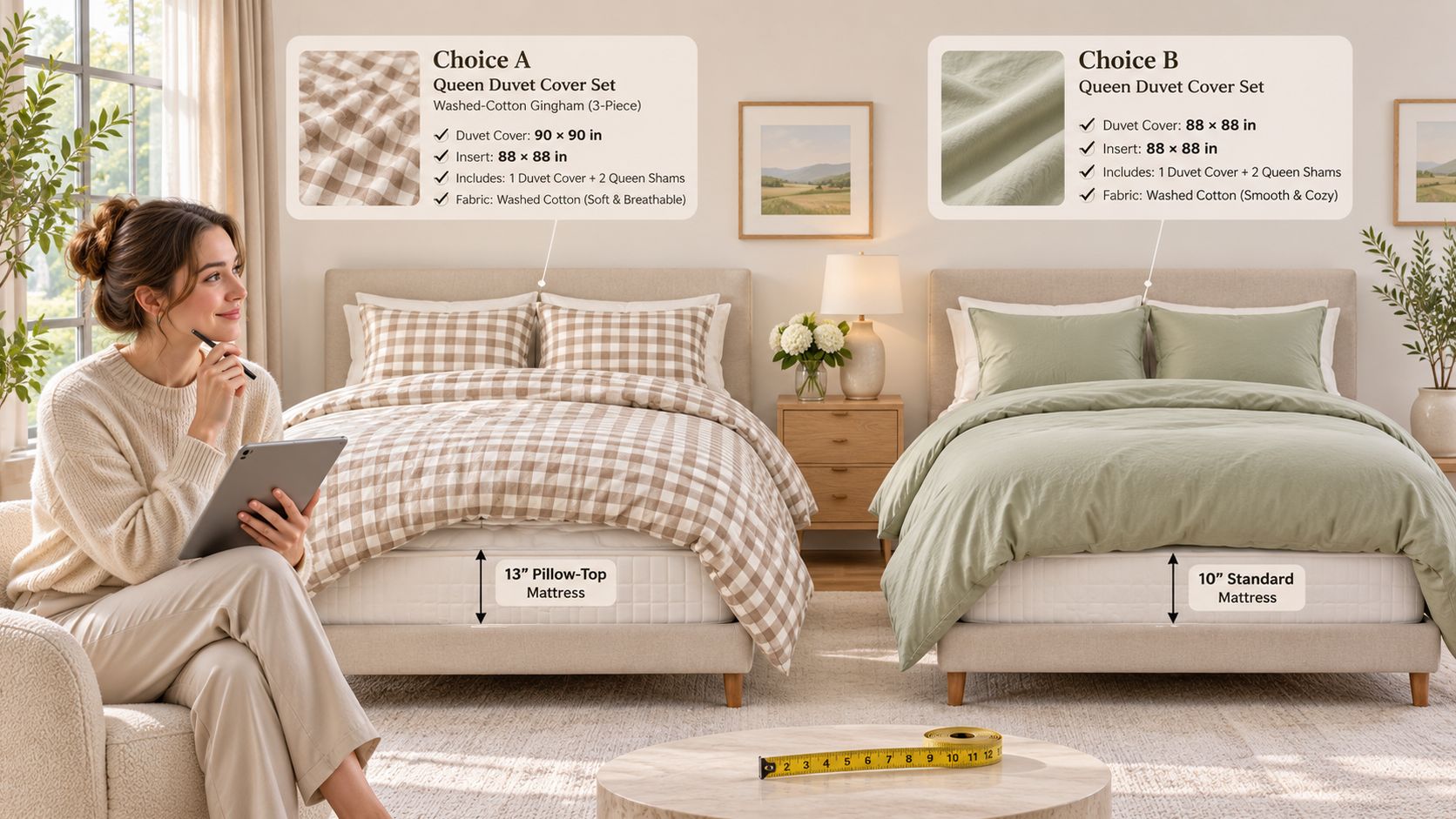
The width gives 15 inches of theoretical side drape. Subtract 13 inches of mattress and roughly two inches remains. That's a fitted look, almost a tuck, with no flowing skirt at the floor. If that's the goal, buy it. If the shopper pictured fabric pooling near the rug, the same set in a 92 × 90 cut, or a size up, gets closer. The washed finish and the warm gingham suit a casual farmhouse room, and cool washing with low heat protects both the fit and the color.
Second scenario: a guest room with a standard 10-inch mattress and a 90 × 92 inch sateen set at 400 thread count, shams at 20 × 26 inches. Here the extra width reads as graceful drape rather than excess, because the mattress isn't eating the overhang. The sheen dresses the room for very little effort. The trade-off is real: sateen's long floats snag more easily, so a guest room shared with a dog or a cat will show pulls faster than a percale cover would.
Notice what didn't decide either purchase. Nobody stood in a store asking whether the box said queen. The insert size, the mattress depth and the desired drop did all the work.
On price, a three-piece cotton set needs to earn its place. Average duvet-cover prices in North America and Europe reached USD 95 to 150 in 2024, according to DataIntelo's duvet cover and pillow case market report. A set inside that band is fair value when the listing states fiber, weave, exact dimensions and closure type. A set below it can still be good, but check what was left out of the spec sheet rather than what was left out of the price.
That benchmark is also why reading a second listing pays. Rooms with a different mood, such as a velvet plush shaggy duvet cover set in full/queen, solve a texture problem rather than a cotton problem, and they follow the same measuring rules before you order.
Run your own mattress depth and insert size through the first scenario. Fifteen minus your depth is your real drape. If the answer is under three inches, you're choosing a fitted bed, not a draped one.
Five-Point Pre-Purchase Check Before You Buy
Two minutes at checkout prevents a return shipment. Run these five checks on any duvet cover set queen listing you're considering, including ours.
- Exact dimensions are printed. The listing names cover width and length plus sham size. If the only size word is queen, you're guessing.
- The numbers match your insert. Within about two inches per side of your measured insert, no more.
- Fiber and weave are named. Plus wash temperature and drying limits. "Premium cotton blend" tells you nothing about shrinkage.
- The cover has a real closure and corner ties. A hidden zipper or buttons, and ties at all four corners.
- The return policy covers a trial. Long enough to put the set on your bed, not just to open the box.
Apply the checklist to our Tan Gingham Duvet Cover Set – Queen, a three-piece 100% washed cotton set currently at $151.99 USD. Confirm the cover and sham dimensions, the closure, the care label and the return terms on the product page before you order, because those details decide fit far more than the word queen does.
If you're refreshing the rest of the room while you're at it, the same logic applies to layers you don't measure: a reversible khaki checkered throw blanket sized at 50 × 60 inches works on a sofa arm or across the foot of the bed without competing with the bedding.
Measure the insert, read the fabric specification, then order once.
Crown Home Finds ships bedding and home textiles from US warehouses, with free US shipping and a 30-day return window, so you can measure, order and check the fit on your own bed without a long wait. Our bedding collection centers on washed cotton covers and coordinated shams, the construction this guide keeps pointing back to. Start with your insert dimensions and your mattress depth, then browse the full range at Crown Home Finds.
Produced via the Outrank app