

What Is a Towel Warmer? Types, Safety and Benefits
A towel warmer is an electrically heated rack or enclosed bucket that warms towels to a low, comfortable surface temperature of about 65°C (149°F), not a room heater. That's roughly the warmth of a hot bath, which is why the fabric feels inviting against your skin rather than scorching.
The moment it's built for is unglamorous and specific. You step out of a hot shower, reach for the towel on the bar, and it's cool and faintly damp from whoever used it last. Ten seconds of warm cotton against your shoulders changes how the whole morning feels, and that's the entire product promise. It isn't a bigger bathroom or a better shower. It's one square foot of warm fabric at the right moment.
Towel warmers come in two broad shapes, a rack you drape towels over and a bucket you drop them into, and both do the same job by different means. What follows covers how the heat travels, where the device belongs in a bathroom, and which electrical questions to settle before you spend anything.
Table of Contents
- What a Towel Warmer Is in Plain Terms
- How a Towel Warmer Heats Your Towels
- Benefits, Limits and Everyday Uses
- Main Types of Towel Warmers Compared
- Where to Place a Towel Warmer in the Bathroom
- Electrical Safety and Buying Checklist
What a Towel Warmer Is in Plain Terms
Strip away the showroom photos. Searching for what is a towel warmer usually turns up price ranges before it turns up a definition, so start here: it's a small appliance that raises the temperature of the fabric you're about to use. It warms towels, bathrobes and blankets to a gentle, skin-friendly warmth. It does nothing measurable for the air in the room around them.
Think of the heated seat in a car. That seat warmer doesn't heat the cabin. It heats the surface your body touches, and that's enough to change how the first five minutes of a winter drive feel. A towel warmer works on the same principle. The object you touch gets warm, and everything else stays exactly as it was.
Two Forms, One Job
A wall-mounted rack is a set of heated bars that replaces or supplements your towel bar, and a plug-in bucket is a lidded container that warms whatever you place inside it. Same purpose, very different installation, which is why the comparison deserves its own section later.
The temperature is the part people misjudge. Surface warmth on these units sits in the range of a hot bath rather than a cooking surface, so a towel comes out comfortable, not dangerous. Expect oven-level heat and you'll be disappointed. Expect fabric that feels like it just came off a radiator and you'll get precisely that.
What It Is Not
Three mistaken expectations cause most returns. A towel warmer isn't a clothes dryer: a soaked towel won't come out dry in any reasonable time. It isn't a space heater: the output is tiny next to anything built to warm a room. And it isn't a substitute for ventilation, because a damp towel left hanging in a closed bathroom stays damp no matter how warm the bar under it gets.
Here's the simplest test. If you want a warm towel at the start of your day, you're looking at the right appliance. If you want a warm bathroom, you're looking at the wrong one.
How a Towel Warmer Heats Your Towels
A towel warmer transfers low-temperature heat to towels through two routes: conduction where the fabric touches a warm surface, and natural convection where warmed air moves through the folds. The published figures for one representative rack, the Barcelona wall-mounted towel warmer, show how gentle those numbers are: an average surface temperature of 149°F (65°C), a heat-up time of about 15 to 20 minutes, an output of roughly 512 BTU per hour, and capacity for one to two towels.
The sequence runs in four stages.
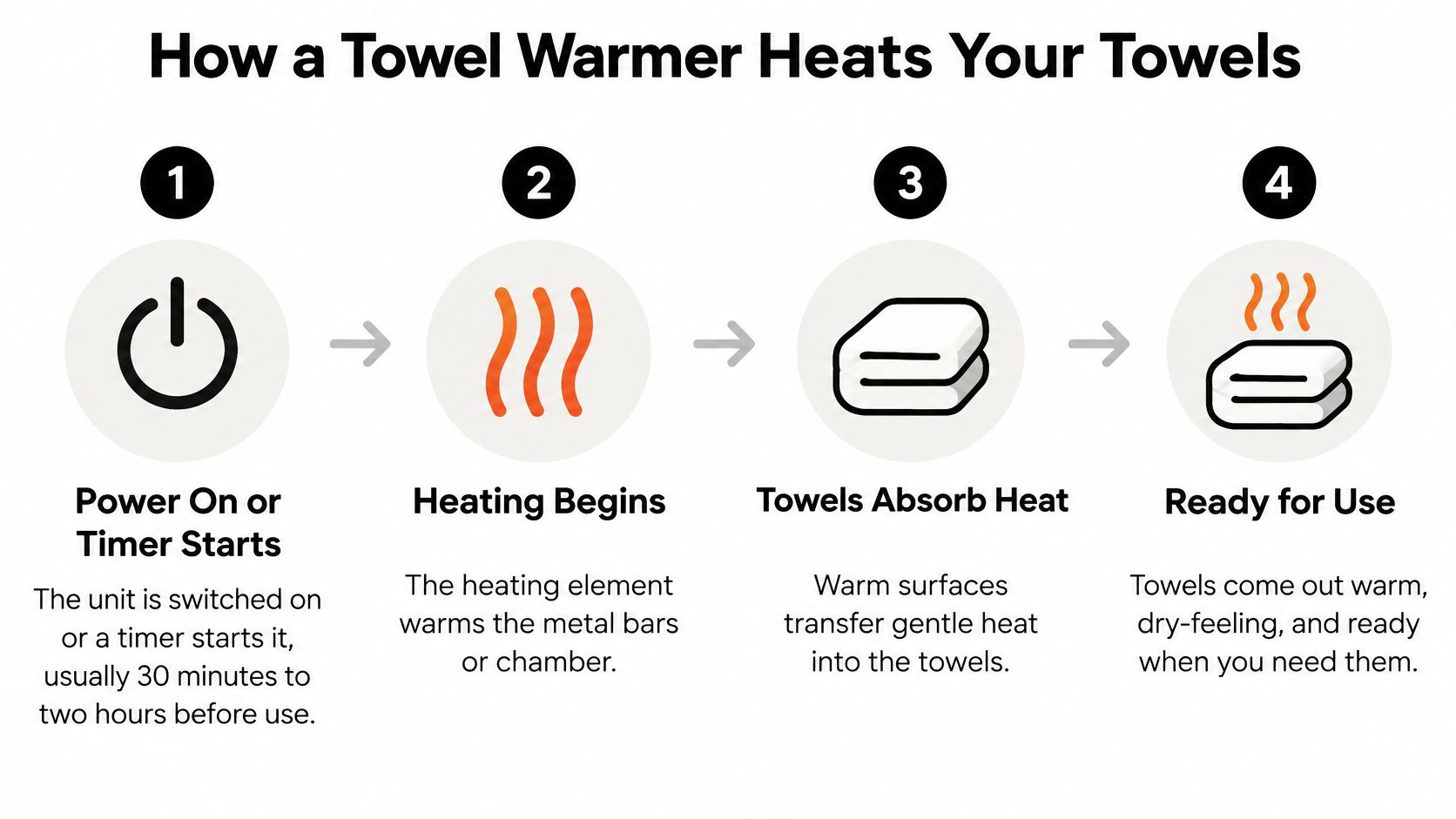
- Power on or the timer starts. Switch the unit on well before you need it, since the rack takes a while to reach working heat and then holds its warmth well.
- The heating element warms the metal bars or the chamber walls. That climb from room temperature to working heat is the slowest part, which is why the pre-use window matters more than the wattage on the box.
- The towel absorbs heat wherever it touches. Every point of contact is a conduction path, so a bar pressed against fabric warms far faster than the stretch of towel hanging next to a narrow gap of air.
- Air circulates through the folds. Natural convection lifts warm air up through loosely draped fabric, and that's why the way you hang a towel changes the result as much as the appliance does.
An output that gentle can't brute-force its way through fabric, so technique decides the result. A towel draped loosely across several bars gives the heat far more contact area than the same towel bunched into one thick pad, and a stacked bundle blocks the airflow that evens the warmth out.
Hang it loose: a towel spread over three bars warms through faster than one folded double, because a folded towel insulates itself from the heat it's sitting on.
If you'd like to watch the cycle from switch-on to ready, this short walkthrough covers it.
What should the result feel like? Warm through the middle, never scalding on the outside. If the outer face is hot to your hand and the centre is still cool, the towel is bundled too tightly for the heat to travel.
Benefits, Limits and Everyday Uses
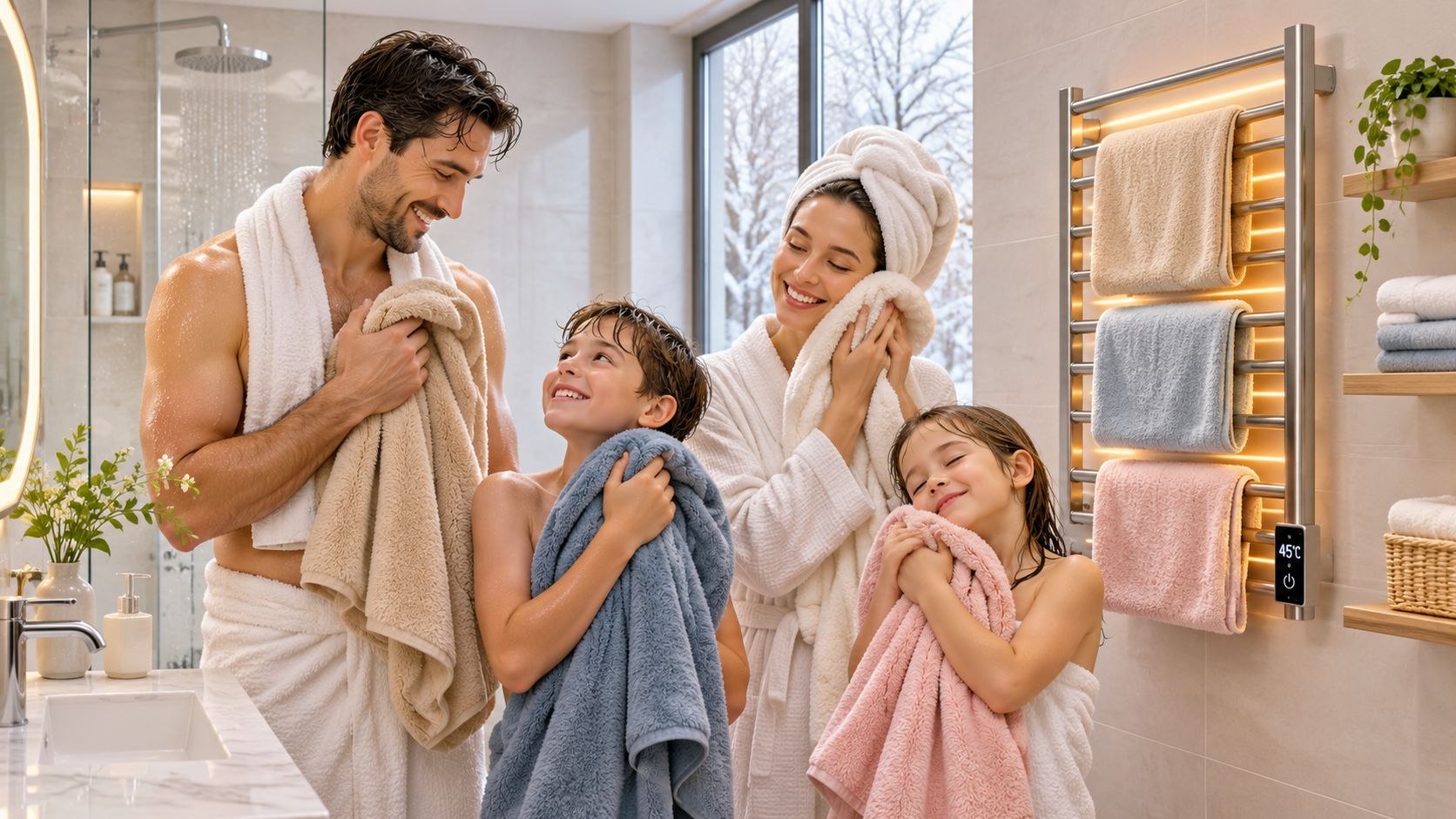
Picture a weekday morning in a house with one bathroom and four people in it. By the time the last person finishes, the first towel on the bar is cool and carrying someone else's damp. A warmer solves that narrow problem well: everyone pulls a towel that feels dry and warm, and the room gains a surface that never gives you a shock when you brush against it.
Three Rooms, Three Different Jobs
The family bathroom benefits most from capacity and timing. Set a timer for 30 minutes before the household wakes up and the towels are ready as the first shower finishes.
A cold bathroom with no radiator gains a warm, dry surface where there was only cold tile and a chrome bar. It won't lift the room temperature, but bare feet and wet hands notice the difference.
A guest bathroom turns a small courtesy into something visitors remember, because a warm towel reads as hospitality in a way a folded stack never does.
The idea extends past towels. A robe pulled warm off a rack after a bath is the same comfort in a different shape, and a long plush fleece robe is the kind of thick fabric that benefits most. Blankets work too, but only on models rated for them, so check the manufacturer's stated capacity rather than assuming a towel rack can handle a throw.
What It Won't Do, Said Plainly
- It won't heat the room. Small output, fabric-focused design, no substitute for a radiator.
- It won't sanitize. Warmth is not disinfection, and a towel that smells musty needs washing, not warming.
- It won't dry fast. A clothes dryer moves air and tumbles fabric. A rack does neither.
- It won't save energy if left on all day. A timer is the cheapest fix for that habit.
A warmer adds comfort to a routine. It does not dry laundry or heat a cold room, and treating it as either leads to disappointment.
Main Types of Towel Warmers Compared
Choice is the difficulty here. The towel warmers market was valued at USD 603.92 million in 2024 and is projected to reach USD 958.93 million by 2032, according to Credence Research's 2024 market report, and most of that variety comes down to how a unit is powered and where it can physically live.
| Type | Power Connection | Heat-Up Time | Towel Capacity | Best For |
|---|---|---|---|---|
| Plug-in bucket warmer | Standard outlet on a GFCI circuit | Fast, since the towel sits in a closed chamber | One or two towels in a typical bucket | Renters and small bathrooms |
| Wall-mounted electric rack | Hardwired by a qualified electrician on a GFCI circuit | 15 to 20 minutes on a representative model | 1 to 2 towels | New installations and permanent placement |
| Freestanding electric rack | Plugs into a GFCI outlet | Similar to a wall rack, same heated bars | 1 to 2 towels | Bathrooms without wall space for mounting |
| Hydronic heated towel rail | Connected to hot water or central heating | Follows the heating system, so it warms with the house | 1 to 2 towels | Homes already running hot-water heating |
A plug-in bucket sits on the floor or a counter. You load a towel, close the lid, and come back to a hot one. No wall work, no electrician, which makes it the only realistic option in a rental. The trade-off is honest: it heats the towel you put inside it and does nothing for the towel bar by the sink.
A wall-mounted electric rack is the permanent answer. It goes in during a renovation while the walls are open, replaces your towel bar, and keeps towels warm and hanging between uses. A freestanding electric rack splits the difference, plugging in with no fixing at all, which helps where the wall is tile over concrete board.
Hydronic rails use no electric element at all. They connect to your hot water or central heating, so they warm up with the house and stay warm as long as the system runs.
How to Read a Towel Warmer Spec Sheet
Five specifications decide whether you'll be happy, and a listing that omits them is telling you something. Check the warm-up time, the rated wattage, the towel capacity, the average or maximum surface temperature, and whether the unit is a rack or a bucket-style chamber. Those five let you compare comfort, capacity and running cost instead of comparing photographs.
Match the type to your situation rather than to a ranking. Rental, finished bathroom, no wall work wanted: bucket or freestanding rack. Renovation with the walls open: hardwired wall rack. Tight footprint and a small budget: bucket or a compact rack.
Where to Place a Towel Warmer in the Bathroom
Clearance decides the spot before aesthetics get a vote. One published installation FAQ specifies keeping a heated towel rack at least 24 inches from wet locations such as showers and tubs, per the Tahoe towel warmer installation guidance. Treat that as a US-focused working example rather than a universal rule. Your product manual and local electrical code control, and in a small bathroom the manual may rule out the wall you had in mind entirely.
Then confirm how the unit draws power. A plug-in bucket needs a protected outlet within cord reach, so small bathrooms usually put it on the floor or a counter outside the splash zone. A hardwired rack needs a wall cavity and a licensed electrician, which suits a renovation far better than a finished room.
Measure in this order before you buy.
- Note the available space. Wall width for a rack, footprint for a bucket or freestanding unit.
- Measure from the tub and shower edge. Anything under 24 inches sends you looking for another wall.
- Trace the cord or connection point. Cords shouldn't cross standing water, the shower curtain line, or a walkway where someone will trip.
- Mark the outlet or the electrician's connection point so you know the warmer will reach before anyone opens a wall.
A tight footprint usually points to a bucket or a freestanding rack, and a renovation points to a hardwired wall unit. If the room is being rethought anyway, our bathroom collection covers the storage and fittings that pair with a warmer without crowding it.
Put the warmer where a dry towel is within reach and a wet hand never reaches a switch.
Electrical Safety and Buying Checklist
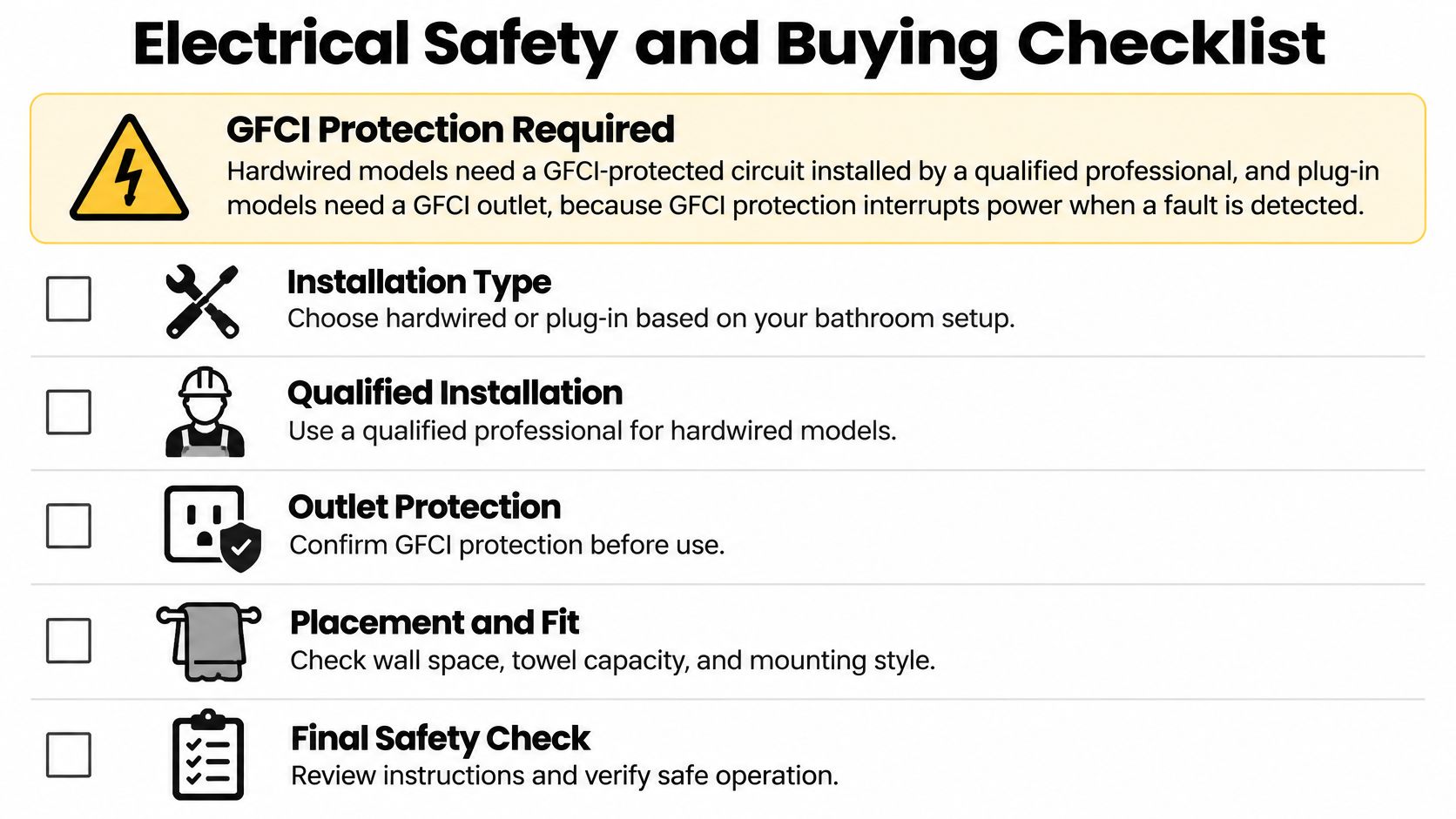
A towel warmer heats fabric, yet it lives in the wettest room in the house, so the purchase turns electrical the moment you pick a wall. Manufacturer technical guidance on the Studio towel warmer support page states the rule that decides the installation: hardwired models should be connected to a GFCI-protected circuit by a qualified professional, and plug-in models should use a GFCI outlet.
A GFCI works like a reflex in the circuit. It compares the current leaving the outlet with the current coming back, and when some of it leaks away through moisture or a damaged heating element, it cuts the power before that stray path can pass through a person.
Wattage does not soften that risk. A modest heater on an unprotected outlet beside a running shower is still an unprotected appliance in a wet room.
The checks below condense the electrical and buying questions into one pass.
Thermal limiting is the second layer of protection. Many warmers include an automatic thermal cutoff that switches the heater off if the surface climbs past its design limit, which matters when a towel drapes flat over the bars and traps heat against them. Look for a recognized safety certification mark on the listing or the rating plate rather than assuming every plug-in rack carries one.
Running costs stay modest. The same manufacturer guidance reports a 150-watt unit running continuously at about $0.59 per day, and a 100-watt model at about $0.13 per day, under its stated assumptions. Local rates and how long the unit runs change those figures, so a timer does real work on the bill as well as on the towel.
Before you buy: confirm the certification mark, the plug or hardwire requirement, GFCI compatibility, automatic shutoff, and the bathroom installation instructions.
Three Questions to Settle First
Is a GFCI-protected outlet within reach of where the warmer will sit? Can a qualified electrician hardwire a unit on a GFCI circuit, and is that worth doing in this room? Is the warmer for towels only, or will it also take blankets and robes?
The Four-Step Purchase Check
- Confirm certification and connection type. Look for the mark first, then check whether the unit plugs in or needs hardwiring.
- Match capacity to the household. A two-towel rack suits a couple. A family of four needs more bars, or a timer that keeps pace with the queue.
- Check warm-up time, wattage, and shutoff or timer. Those three predict a weekday morning and the electricity bill at the end of it.
- Read the bathroom installation instructions before the return window closes. Clearance, cord routing and mounting height all live in that document, and a missed detail is easiest to fix before the unit is on the wall.
Two listings in the Crown Home Finds catalog put these checks into practice. The Large Towel Warmer Bucket for Bathroom with LED Display fits two oversized towels, bathrobes and blankets, and the Hot Towel Warmer Cabinet, 8L Professional Spa Towel Warmer with Auto Warm, Premium Aluminum Interior, Light Blue is on sale at $201.99 USD. Compare either against the four steps above, and confirm the electrical requirements in the product manual before ordering.
A warm towel at the right moment is the small luxury our bathroom comfort range is built around, from towel warmer buckets and cabinets to the thick robes and blankets worth warming in the first place. Browse Crown Home Finds to compare the towel warmer options side by side, with prices in US dollars, shipping from US warehouses, and free US shipping on your order. Start with the room you have, then pick the unit that fits its outlets, its clearance and its morning routine.
Crafted with Outrank