

King Size Pillowcase Dimensions: Sizes and Fit Guide
A standard US king pillowcase measures 20 by 36 inches, about 51 by 91 centimeters. That's the conventional labeled size, not a guarantee of the case's finished, sewn dimensions.
| Case size | Nominal size (in) | Approximate size (cm) | Surface area (sq in) |
|---|---|---|---|
| Standard | 20 × 26 | 51 × 66 | 520 |
| Queen | 20 × 30 | 51 × 76 | 600 |
| King | 20 × 36 | 51 × 91 | 720 |
Table of Contents
- King Pillowcase Dimensions at a Glance
- Why King Pillowcase Sizes Vary by Market
- Nominal and Finished Sizes for Each Case Type
- How to Measure Your Pillow Before Buying a Case
- Choosing a Case Construction for Thick Pillows
- How King Cases Fit Standard King, California King and Queen Beds
- Reading Sham and King Listings Without Confusion
- Quick Fit Checklist and Next Steps
King Pillowcase Dimensions at a Glance
The US size progression above follows the Living Spaces pillowcase size guide: standard, queen, and king share a 20-inch nominal width, while their lengths increase from 26 to 30 to 36 inches. Using those nominal dimensions, a king case has 720 square inches of flat surface area, about 38.5% more than standard and 20% more than queen.
The practical difference is length, not a wider opening. Moving up to king gives a longer pillow more coverage, but it doesn't automatically solve a tight fit around a bulky insert.
That distinction matters when you're replacing a case. If your pillow fills its current cover across the width but leaves the end stretched tight, a longer case may help. If the fabric pulls across the pillow's middle, length alone may not address the problem.
What the label actually tells you
Nominal size means the size category the product is intended to fit. It's a useful starting point for shopping, but it isn't a complete description of the fabric you'll receive.
Manufacturers can include additional material for an opening, hem, internal flap, or decorative border. A listing may therefore describe the intended pillow rather than the case laid flat on a table.
Practical rule: Treat the size name as a category, then use the finished measurements to judge fit.
The surface-area comparison also needs context. It describes a flat rectangle, not the usable interior volume of a pillowcase. It doesn't tell you how much room remains once a thick pillow pushes the fabric outward.
For international shoppers, metric measurements make comparison easier, but converting units doesn't remove differences in construction. Before buying, match the listing to your actual pillow and establish whether the measurements describe the insert or the sewn case.
Why King Pillowcase Sizes Vary by Market
King sizing developed through regional bedding conventions rather than a single worldwide specification. The Silk pillow-size explanation traces that variation to local textile-making traditions, when households and craftspeople made bedding to suit local preferences rather than one international system.
Modern retail labels still reflect those differences. A familiar size name can mean something different when you buy from a seller serving another country.
Construction terminology can differ too. US pillowcases commonly have a simple bag-style opening, while European cases more often use an internal pocket, sometimes called a housewife closure. That pocket holds the pillow inside without leaving the same exposed opening as a basic bag-style case.
Check the specification, not the country label
Neither construction is the correct choice for every sleeper. The important question is whether the seller describes the usable fit clearly.
A useful international listing identifies:
- Finished dimensions: The measurements of the completed case, not merely its size category.
- Measurement basis: Whether the stated dimensions describe the pillow insert or the cover.
- Closure design: Open end, internal pocket, zipper, or another fastening.
- Border treatment: Whether decorative fabric sits outside the insert compartment.
A product photo can help identify the opening, but it can't reliably establish the interior size. Folded fabric, styling, and camera angles can hide the details that determine fit.
When ordering from an unfamiliar or overseas seller, ask for the finished case dimensions and closure type before purchasing. If the response only repeats the word king, you still don't have enough information to compare the product with your pillow.
Nominal and Finished Sizes for Each Case Type
Nominal size, finished size, and cut size describe different things. Nominal size identifies the intended fit category. Finished size describes the completed case, while cut size describes fabric before sewing consumes material in seams and hems.
An open-end case makes the distinction especially clear. The Bedelite pillowcase sizing guide pairs a 20 × 36-inch king pillow with an approximately 20.5 × 40-inch finished open-end case, allowing about 4 inches of extra length and 0.5 inch of extra width.
Extra allowance by case construction for a king pillow
| Case construction | Extra length | Extra width | Expected fit |
|---|---|---|---|
| Open-end or tuck-style | About 4 in, finished about 40 in | About 0.5 in | Roomier, with a tail covering the pillow |
| Envelope closure | Check usable compartment length; flap overlap isn't all usable space | Check finished interior width against insert | Overlap adds fabric; check the finished size |
| Zipper or fitted | Close to insert size | Close to insert size | Snug; check loft before buying |
Those open-end allowances are a construction example, not a universal manufacturing rule. Don't assume every king case includes the same extra fabric.
How the closure changes the fit
An open-end case uses additional length to cover the pillow near the opening. An envelope case instead uses an overlapping pocket, so some fabric serves the closure rather than extending the usable compartment.
A zipper closes the opening directly. That makes accurate sizing particularly important because you can't compensate for a short compartment by leaving a loose tail.
Compare the space that holds the pillow, not every piece of fabric attached to it.
Before selecting a close-fitting design, measure the insert seam to seam and consider how its loft fills the case. Check the laundering instructions too, especially if the seller doesn't clarify whether finished measurements apply before or after washing.
How to Measure Your Pillow Before Buying a Case
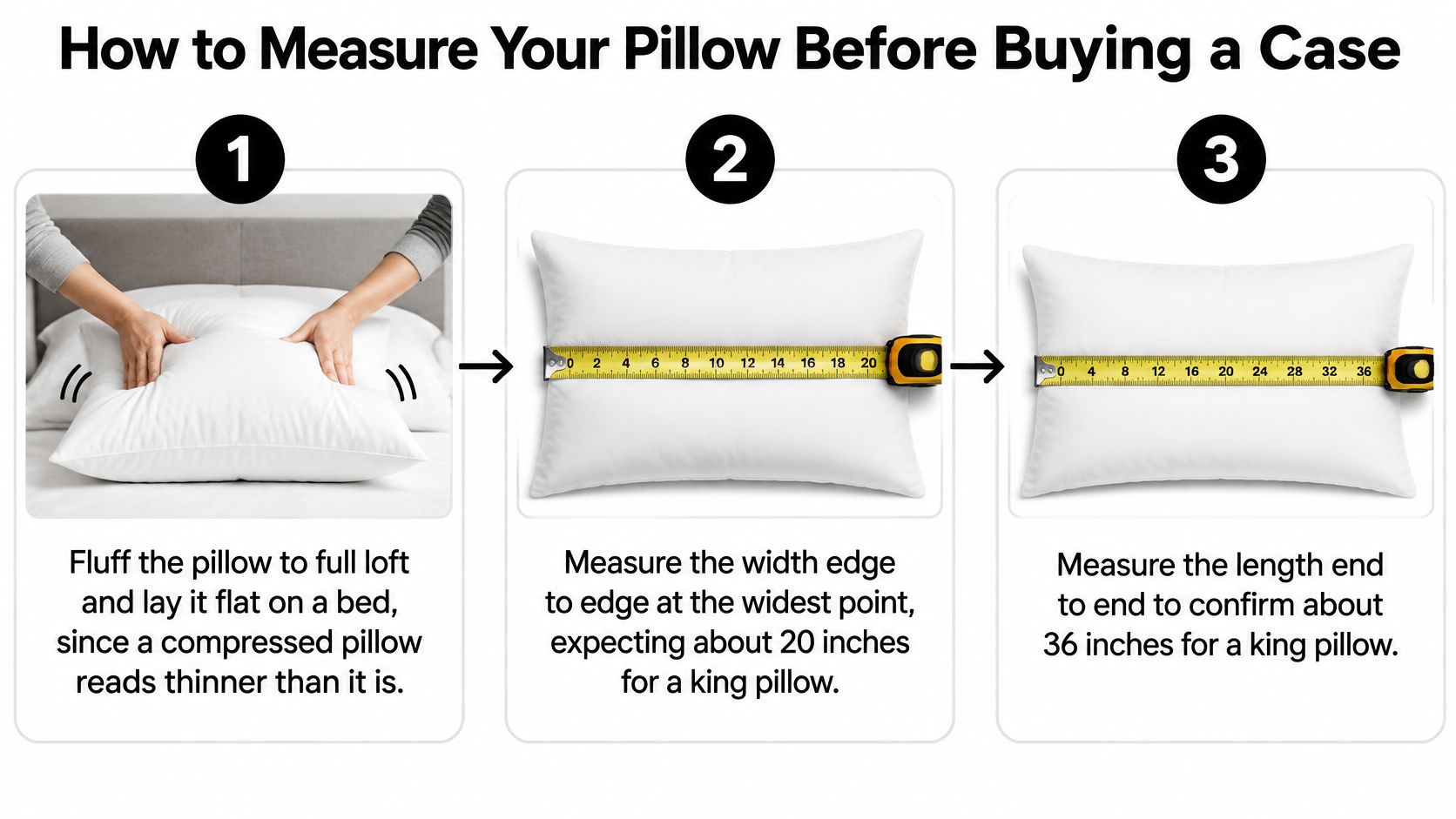
Use a flexible measuring tape and record your measurements in a phone note. Measure the pillow you use, not its packaging or the flattened shape it takes when stored.
The How Long Things pillow-dimension guide identifies a common king pillow as 20 × 36 inches, while king cases can extend to roughly 20–21 inches wide and 36–41 inches long, reflecting different closures and allowances. That spread explains why the size label alone can't settle a fit question.
Record the pillow's real shape
- Fluff it to full loft. Lay it on a bed and let the filling settle naturally, since compressing it makes the thickness reading less useful.
- Measure across the width. Run the tape edge to edge without squeezing the pillow or pulling the seams inward.
- Measure the length. Record the distance between the end seams, excluding tags and unrelated fabric overhang.
- Check the thickness. Measure the lofted center, and note any gusset that gives the pillow a deeper, box-like edge.
- Compare like with like. Match these measurements to the seller's finished compartment dimensions or stated insert compatibility.
- Check the opening. Establish whether the closure needs additional coverage, an overlapping pocket, or a close-fitting fastening.
- Consider laundering and wear. Follow the care label and consider whether the case may shrink or the pillow may settle with use.
Don't pull the tape tightly around a curved surface and record that as the flat width. You want measurements that describe the pillow consistently, not a circumference that the seller's chart doesn't use.
Bigger isn't automatically better
An oversized case can leave fabric that bunches beneath your face or makes the pillow appear underfilled. A snug case can hold the shape neatly, provided it doesn't compress the insert or strain the closure.
The useful test is simple: the case closes without force, the seams don't pull, and the fabric lies smoothly across the pillow. If you must fold or crush the insert to fasten it, the fit needs reconsidering.
Choosing a Case Construction for Thick Pillows
A thick pillow needs room around its body, not just additional fabric beyond its end. Memory-foam, gusseted, and overfilled pillows can therefore expose a weakness in listings that describe length but say nothing about depth or compatible loft.
Start with the center thickness you recorded. If the seller lists a finished depth, compare it directly; if the case is a flat construction, ask whether it accommodates your pillow's profile.
Choose by where the fabric needs room
| Pillow characteristic | What to examine | Construction consideration |
|---|---|---|
| Deep gusset | Room around the side panels | Avoid a cover that pulls the gusset inward |
| Firm memory foam | Opening size and usable compartment | The insert may not compress easily during fitting |
| Plump fiber fill | Freedom to redistribute filling | Look for smooth coverage without excessive compression |
| Soft, flatter fill | Loose fabric after settling | A closer-fitting closure may look tidier |
An open-end case can be easier to put on a bulky pillow because you don't need to bring fastening edges together. However, a longer tail won't rescue a compartment that's too narrow.
An envelope case should retain enough overlap after the pillow fills it. If the pocket pulls open, the usable fit is too tight even when the outer fabric initially appears long enough.
Fit test: A closure should hold the pillow in place, not act as a strap that compresses it.
For a zipper case, check that the fastening closes smoothly without drawing the pillow's corners inward. Don't force the slider against tension.
There isn't a universal thickness cutoff that makes one closure suitable for every pillow. Choose the construction whose usable allowance matches the pillow's lofted shape, and follow the fabric's care instructions to protect that fit.
How King Cases Fit Standard King, California King and Queen Beds
Pillowcase fit and bed styling are separate decisions. Choose the case for the pillow, then judge how the covered pillows sit across the mattress.
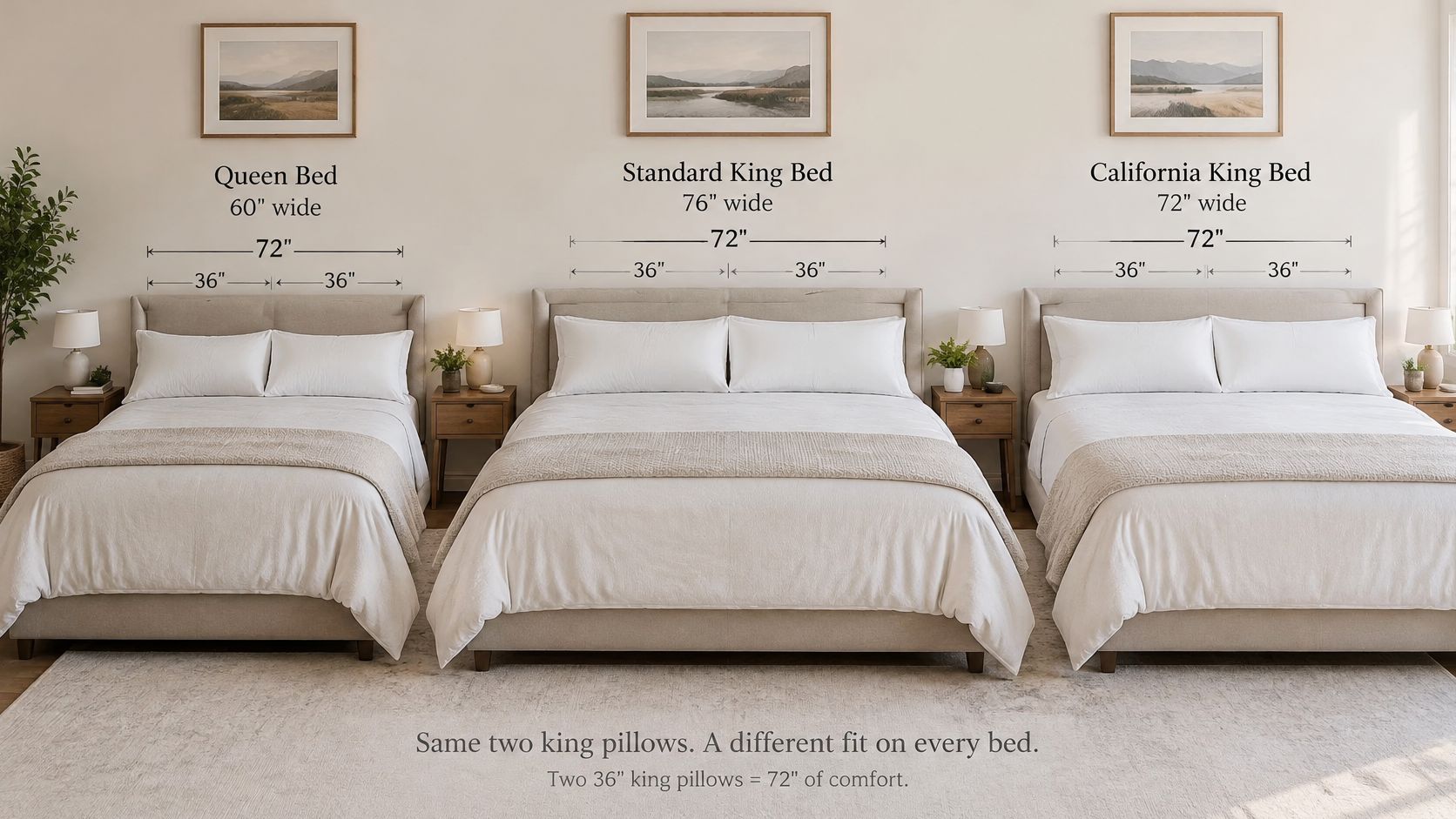
The Sleep Foundation pillow-size guide identifies king pillows as 20 × 36 inches; placed end to end, a pair spans 72 inches, aligning with a California king's width and leaving about 4 inches spare across a standard king. The table applies that comparison and includes a hypothetical queen-width example.
Two king pillows across common mattress widths
| Bed | Mattress width (in) | Two king pillows (in) | Resulting fit |
|---|---|---|---|
| Queen, hypothetical 60-inch-wide example | 60 | 72 | Pair extends 12 in beyond the mattress width |
| Standard king | 76 | 72 | About 4 in spare |
| California king | 72 | 72 | Aligned with the mattress edges |
Decide which visual line you want
On a standard king, the pair can sit slightly inside the mattress edges. On a California king, the pillow bodies create a fuller edge-to-edge arrangement.
A narrower bed requires a different styling decision. You might overlap the pillows, angle them, or accept overhang, but a different pillowcase won't shorten the inserts.
These comparisons describe the pillow bodies. Loose tails, decorative borders, and the way you position the pillows can change the visible outline.
If you're coordinating the rest of a queen bed, the queen duvet cover set guide addresses a separate bedding choice. The mattress size doesn't mean every textile on the bed must carry the same size label.
Measure your mattress width and decide whether you want the pillows inside the edges, aligned with them, or deliberately overlapping. Then keep the sleeping cases matched to the inserts.
Reading Sham and King Listings Without Confusion
A listing can say king pillowcase while giving the outer dimensions of a decorative cover. That doesn't necessarily make the product incorrectly sized, but it does make the description incomplete if you can't tell what those dimensions represent.
A sleeping pillowcase is intended for regular contact during sleep. A decorative sham is primarily a styling cover and may include borders, a fitted compartment, or a closure positioned for display rather than nightly convenience.
Use a consistent listing check
- Identify the measured object: Does the figure describe the insert, the completed cover, or its outside border?
- Separate nominal from sewn size: A size category isn't proof of the finished compartment dimensions.
- Find the closure: Inspect the description and photos for an open end, envelope pocket, or zipper.
- Read the metric equivalent: Check that the units describe the same measurement basis.
- Confirm the intended use: Look for an explicit distinction between sleeping cases and decorative shams.
For bedding sold together, inspect the component list rather than assuming every included pillow covering is a sleeping case. A duvet cover set described as including shams should prompt you to check those covers' purpose and construction separately.
Don't count a decorative flange as room for the insert. The usable compartment is the space inside the seams that hold the pillow.
Cross-border shopping adds another reason to be precise because familiar names may accompany unfamiliar construction. Compare competing listings only after you've established that both describe the same object, in the same units, on the same measurement basis.
Quick Fit Checklist and Next Steps
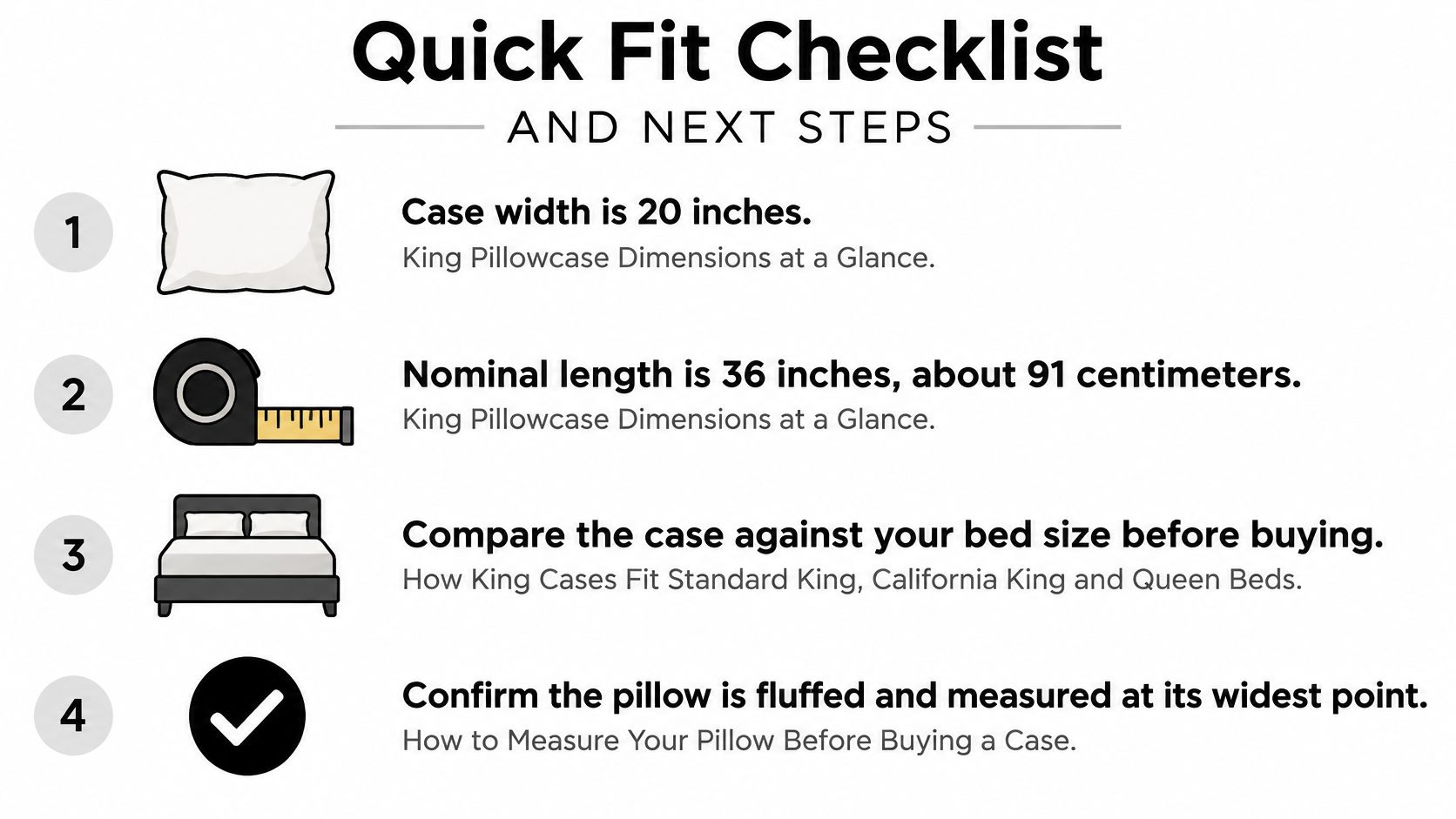
Fit problems usually show up after the case is already on the bed, and they almost always trace back to a measurement that got skipped at checkout. A good purchase decision combines the pillow's numbers, the case's construction, and your preferred arrangement on the bed, so run this checklist before adding a cover to your cart.
- Width confirmed: The usable compartment suits your insert. [King Pillowcase Dimensions at a Glance]
- Length confirmed: The nominal category matches the pillow you measured. [King Pillowcase Dimensions at a Glance]
- Measurement basis clear: The seller distinguishes finished-case dimensions from pillow size. [Nominal and Finished Sizes for Each Case Type]
- Closure allowance understood: Any tail or pocket serves its intended purpose. [Nominal and Finished Sizes for Each Case Type]
- Pillow measured lofted: Your notes include width, length, and thickness. [How to Measure Your Pillow Before Buying a Case]
- Depth accommodated: The cover doesn't flatten the gusset or strain across the center. [Choosing a Case Construction for Thick Pillows]
- Bed arrangement chosen: The pillow pair sits where you want it. [How King Cases Fit Standard King, California King and Queen Beds]
- Product purpose checked: You've identified a sleeping case or intentionally chosen a sham. [Reading Sham and King Listings Without Confusion]
If the label and measurements disagree, trust the measured pillow and the finished compartment. Measure first, compare the listing, select the closure, and check the bed arrangement before ordering.
Keep decorative covers separate in your shopping notes. The Cable Knit Throw Blanket and Pillow Set – Rust contains 3 pieces: a 50 × 60-inch knitted throw and two 18 × 18-inch pillow covers, pieces sized for couch styling rather than king sleeping pillows.
Shop the bedding and bed linens collection at Crown Home Finds with those measurements in hand. Check each listing's stated dimensions and included pieces against your notes, and order only when the description confirms the intended fit.
Made with the Outrank app